Book Free Class
Email: [email protected]
WhatsApp: 074 50 795 944
Your first instinct is to focus on what your child needs to learn.
Maths. English. Verbal reasoning. Non-verbal reasoning. Vocabulary. Timed papers.
All of those things matter. However, here’s a factor that often gets overlooked during grammar school preparation.
How your child actually learns best.
Some children thrive when they can see information clearly laid out in front of them. Others need to hear explanations multiple times before things click. The problem is that many children preparing for exams such as the 11+ revising through methods that simply do not suit them.
This is why two children can spend the same amount of time revising, yet result in entirely different outcomes. I see this time and time again.
While one child leaves a study session feeling confident and motivated, the other may leave convinced they’re “just not good at maths” when they may simply be learning in the wrong way.
I think this becomes especially important with the 11+ because the exam itself is quite unusual. It tests confidence, speed, pattern recognition, comprehension, and the ability to think clearly under pressure. Understanding and identifying different learning styles can make a difference during 11+ exam preparation, or any exam they take in the future.
I think one reason why parents searching for the best 11+ tutor in Kent, the Wirral, Buckinghamshire, or anywhere else in the UK are usually looking for more than just “extra lessons.” They’re want to find support that continuously works for their child.
The children who improve fastest are not necessarily the “smartest” children, they’re the children who finally find a learning approach that makes sense to them.
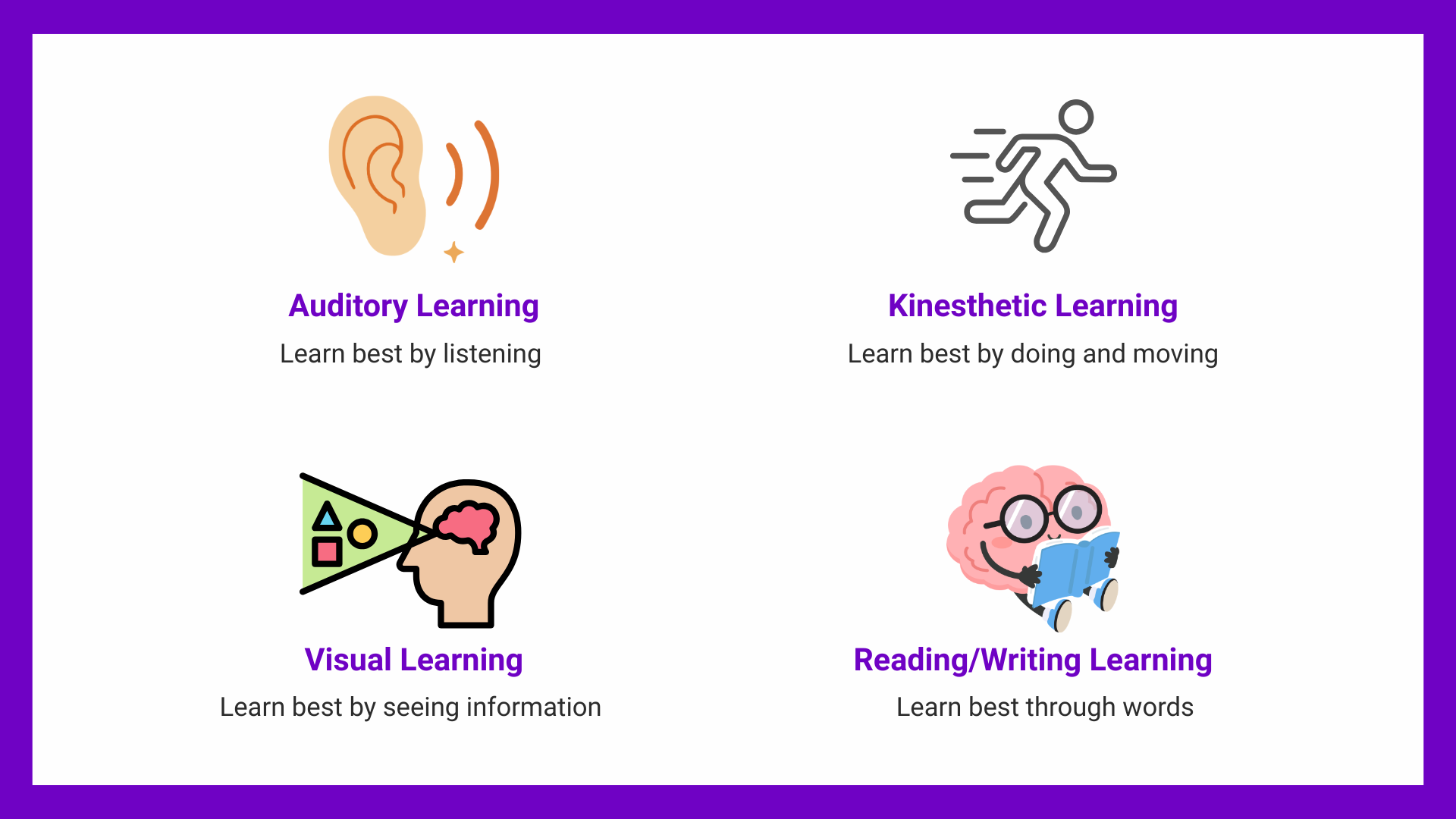
Here’s the 4 learning styles, their characteristics, and how to apply them to grasping Maths.
Auditory learners pick things up far better through listening and discussion.
These children often:
• remember spoken explanations
• ask lots of questions and want verbal answers
• talk through their problems aloud
Interestingly, auditory learners are often misunderstood because they may appear distracted during silent revision, when in fact, they want to process information best through active discussion rather than quiet memorisation. For these children, simply sitting alone with a workbook for two hours is rarely effective.
They benefit much more from:
• discussing mistakes calmly
• hearing concepts explained
• reading questions aloud
• verbally reasoning through answers
Particularly important for verbal reasoning and comprehension sections of the 11+.
These children will understand far more than they initially show once they are encouraged to articulate their thinking. Parents often underestimate is how emotionally important tone can be for auditory learners. A calm explanation often teaches more than a loud correction ever will.
These are the children who simply need movement, action, and interaction.
They usually learn best through:
• active problem-solving
• physically writing methods down (no typing!)
• timed challenges
• hands-on practice
• trial and error
These children are frequently the ones who “switch off” during long periods of passive revision. They may be unfairly labelled as lazy when what’s happening is just struggling with a more “boring” form of learning.
A kinaesthetic learner may understand far more during
a 20-minute active session than during a two-hour lecture-style revision block.
Kinesthetic learners improve best through doing questions, making mistakes, correcting methods, while gradually recognising patterns. Short, focused revision sessions are far more effective than marathon study days. They tend to be self-reliant and have the ability to improve Maths through independent study as long as they are interacting with their material.
There’s a difference between passive and active revision. A lot of children who claim they “hate revision” actually hate passive revision. Passive revision usually involves rereading notes, highlighting textbooks, watching long explanations, or sitting through hours of study without any engagement with the material. For kinesthetic learners especially, this can feel frustrating and ineffective because they are not actively involved in the learning process.
Some children learn best visually, meaning they need to see something tangible to understand a concept.
These are often the children who benefit from:
• colour-coded notes
• diagrams
• step-by-step demonstrations
In Maths especially, visual learners tend to struggle when explanations are too abstract.
If a child is simply told to “just do the method” without actually seeing why the method works, they quickly become confused and disconnected.
Visual learners often need maths to be broken down clearly in front of them before it makes sense. They benefit from seeing patterns, relationships, and structures rather than memorising procedures without understanding.
This visual representation is incredibly important because so many concepts are abstract by nature. Fractions, algebra, graphs, ratios, and geometry all become far easier to understand when these students can see what is happening. A visual learner may grasp algebra far more effectively when colours are used to separate terms, or understand fractions more clearly through diagrams and models rather than verbal explanations alone.
Visual learners often do especially well with:
• non-verbal reasoning
• pattern recognition
• shape-based problems
Step-by-step demonstrations are particularly valuable for these learners because they allow them to follow the logical flow of a problem from beginning to end. Watching a method unfold visually helps reduce overwhelm and gives students a clearer mental picture of the process they are trying to replicate themselves. This is why many visual learners thrive in maths when teaching includes worked examples, visual aids, colour-coding, and clear written structure. They understand their way to a solution faster when they’re able to map out concepts and ideas with a few markers and coloured pens.
These are the children who process information most effectively through reading, writing, and structured note-taking.
They often learn best through:
• writing detailed notes
• reading worked examples carefully
• creating summaries and revision sheets
• rewriting methods in their own words
• following structured step-by-step instructions
Reading/writing learners are the most comfortable with traditional academic environments because so much of school is built around text-based learning. However, they can still struggle when concepts are poorly explained or presented without enough written structure.
In Maths particularly, these students often benefit from seeing clear written methods broken down line-by-line. They like understanding the logic behind each step and often feel more confident when they can refer back to organised notes or worked examples independently.
These learners tend to thrive when revision feels structured and predictable. They often enjoy:
• creating formula sheets
• writing out definitions and rules
• organising topics into folders or checklists
• annotating mistakes carefully after corrections
Unlike kinaesthetic learners who may learn primarily through repetition and trial-and-error, reading/writing learners often improve by slowing problems down and processing them carefully through language and written explanation.
This learning style can be effective in Maths because strong written structure reduces cognitive overload. Traditional textbook-based learning work well on these learners. A messy page or skipped working can quickly confuse these students, whereas neat layouts and clear sequencing help concepts feel manageable and logical.
Many reading/writing learners also become highly independent once they have strong notes and examples to work from. They revisit material repeatedly, gradually strengthening understanding through careful reading, written repetition, and self-testing. In subjects like algebra, problem-solving, and word sums, this methodical approach can become a major strength over time.
Your child shouldn’t be expected to be able to learn of a textbook because his classmates can.
Some children need structure.
Some need repetition.
Some need encouragement.
Some need challenge.
Some need quiet.
Some need interaction.
And during exam preparation, those differences become very obvious very quickly. Parents become frustrated when their child does not pick up generic revision strategies they’ve found online. A beautifully organised revision timetable means very little if the child isn’t engaging with Maths properly. Similarly, endless practice papers are not always the answer.
That’s one reason structured 11+ tutoring can be so valuable when done properly.
Children necessarily need someone who is more than simply “qualified” teaching them, because they also need:
• consistency
• accountability
• confidence-building
• exposure to exam-style thinking
The best tutors are always the ones who can explain difficult ideas simply.
If I’m honest, confidence affects 11+ performance more than many parents realise.
Children who lack confidence:
• avoid difficult topics
• panic under time pressure
• give up too quickly
• assume mistakes mean failure
Confident children tend to:
• attempt harder questions
• stay calmer under pressure
• recover from mistakes faster
This confident cannot appear overnight.
It’s usually built gradually through: understanding, routine, repetition, and celebrating small wins. When children revise in ways that genuinely suit them, they experience more success.
This success creates confidence, which subsequently improves performance.
The cycle starts reinforcing itself positively, impacting their long-term attitude towards Maths.
Most children are not purely visual, auditory, or kinesthetic or reading/writing learners. A child could prefer visual maths explanations but auditory English teaching. They could need active practice for reasoning papers but calm discussion for comprehension work.
The real goal isn’t to place children into neat categories.
It’s simply to notice:
• what helps them engage
• what helps them remember
• what helps them stay confident
And I think that’s what many parents are really searching for when they look up things like:
“why is my child struggling with maths?”
The issue is not immediately intelligence, laziness, or lack of effort. More often than not, the child simply hasn’t been taught in a way that matches how they process information best.When children constantly feel overwhelmed or “behind,” they can quickly begin to believe they are just bad at maths.
Once a child starts experiencing small moments of understanding, success, and progress, their entire attitude towards learning can begin to shift. The most vital step to achieving this is recognising that struggling in one environment does not mean a child cannot succeed.
They need a different approach.
And when teaching begins to match the child rather than forcing the child to match one rigid style of teaching, learning becomes far more enjoyable, and ultimately far more effective.
No. Understanding how your child learns can make revision more effective, but regular practice and consistency are still the biggest drivers of improvement.
Where possible, yes. For example, some children benefit more from videos and diagrams, while others learn better from worked examples, written summaries or interactive practice questions.
Yes. If a child spends hours revising without making progress, they can begin to believe they’re “bad at maths,” when the real issue may be that the revision method doesn’t suit how they learn.
Pay attention to how they naturally solve problems. Do they draw diagrams, talk through answers, write detailed notes or prefer learning by trying things themselves? Their habits often reveal what works best.
Absolutely. Even siblings of a similar age can process information very differently, which is why the same revision method may work well for one child but not the other.
Our tutors don’t teach one way for the entire lesson. Every class is designed to include a mix of explanations, worked examples, discussion, visual demonstrations and active problem-solving, so students naturally engage in different ways.
Students see methods worked through on screen, hear concepts explained, answer questions throughout the lesson and complete regular practice themselves. That combination means visual, auditory, reading/writing and kinaesthetic learners are all actively involved rather than simply watching a tutor talk.